Learn Coding Visually
Learn to code with interactive, live-preview playgrounds — HTML, CSS, JavaScript, React & more.
 HTML Playground42 lessons · Click-based · Live preview
 CSS PlaygroundLearn CSS with a live editor
 JavaScript Playground60 lessons · DOM · Async · Canvas
 React PlaygroundLearn React with a live code editor
 GSAP PlaygroundLearn GSAP animation interactively
 SVG Playground44 lessons · shapes · paths · animation
 SCSS Playground45 lessons · Sass modules · tokens
 Tailwind PlaygroundLearn Tailwind CSS with a live editor
 Bootstrap 5 Playground50 lessons · live preview
Promise.all vs allSettled vs race vs any — Free Interactive Visualizer
Promise.all vs allSettled vs race vs any Visualizer · Visualizers · Plain HTML, CSS & JS · Live preview
What's included
Features
About this UI Snippet
JavaScript Promise Combinators — Four Rules on One Timeline
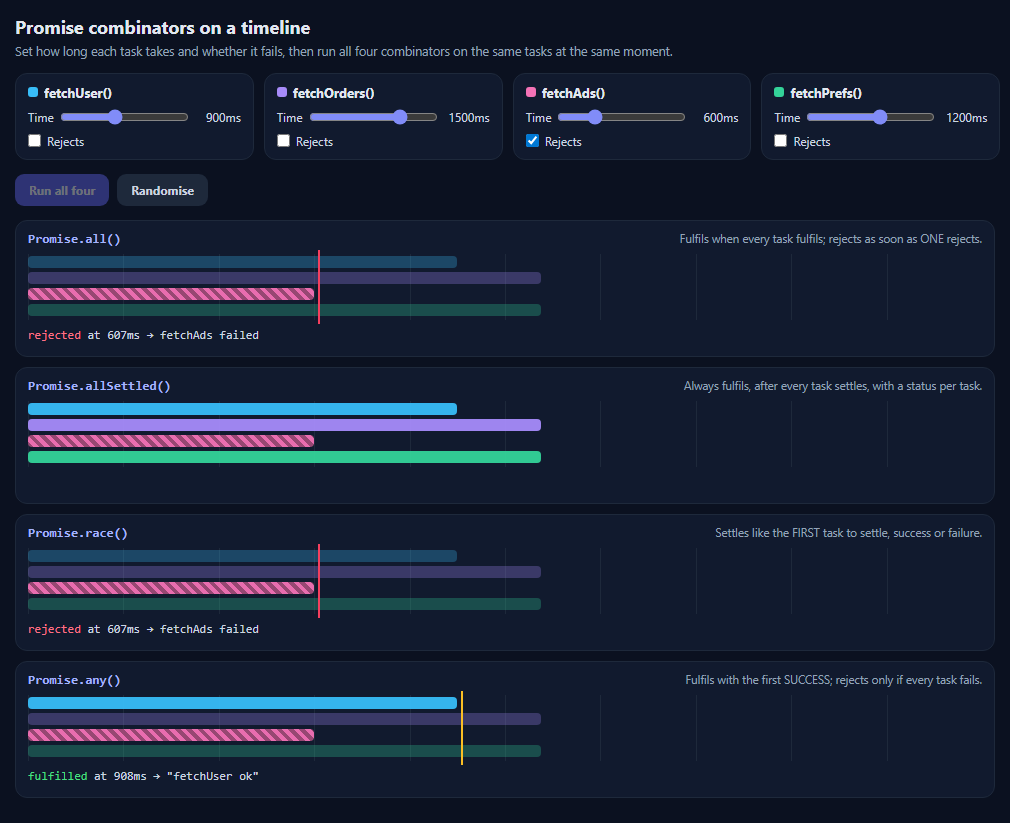
JavaScript has four built-in ways to wait for several promises at once, and they differ in exactly two things: when they settle, and what counts as success. Reading the spec wording is one thing; seeing the same four tasks produce four different outcomes is what makes it stick.
Real promises, same start time
Each task is a real Promise that resolves or rejects after its delay. All four combinators receive the same array of promises at the same moment, so the only difference between lanes is the combinator's rule.
The four rules
- Promise.all fulfils with an array of values when every task fulfils, and rejects immediately when any task rejects — it short-circuits on the first failure.
- Promise.allSettled never rejects. It waits for every task and fulfils with { status, value | reason } objects.
- Promise.race settles the same way as whichever task settles first, success or failure.
- Promise.any fulfils with the first success and ignores failures, rejecting with an AggregateError only if every task fails.
Reading the timeline
Bars grow in real time. Striped bars are rejections. The vertical line marks when the combinator settled — amber for fulfilled, red for rejected — and bars that are still running afterwards fade, because nothing they do can change that combinator's result.
Short-circuiting doesn't cancel
When Promise.all rejects early, the other tasks keep running: promises have no built-in cancellation. The faded bars keep growing to make this visible. Use an AbortController to actually stop network requests.
Unhandled rejections
The raw task promises get an empty .catch() so the browser doesn't report unhandled rejections for promises that are observed only through combinators.
Build with AI
Build, Understand, Optimize, and Extend It With AI
Paste this visualizer into an AI assistant like Claude and ask it to predict each lane's result for a given configuration, then check with Run. Ask it to add AbortController so that Promise.all's early rejection actually cancels the other tasks, a fifth lane for a custom "first N succeed" combinator, or a timeout lane built with Promise.race. It can also explain how microtasks affect the exact order of the settle callbacks.
Prompt to recreate it
Copy this into your AI assistant of choice to build the effect from scratch, or as a jumping-off point for your own variant:
Build an interactive visualizer comparing Promise.all, Promise.allSettled, Promise.race and Promise.any in plain HTML, CSS and JavaScript on a dark theme.

Requirements:
- Four configurable tasks, each with a name, a duration slider (100–2000 ms) and a "Rejects" checkbox.
- Each run creates four real promises that resolve or reject after their durations, and passes the same array to all four combinators at the same moment; attach an empty catch to the raw promises to avoid unhandled rejections.
- One lane per combinator with its rule in one sentence, a timeline where each task's bar grows in real time (striped when it rejects), and a vertical marker at the moment the combinator settled (amber if fulfilled, red if rejected).
- Fade the bars of tasks that finish after a combinator has settled, since they can't affect its result.
- Print each combinator's outcome and value, including allSettled's status list and any's AggregateError.
- A Randomise button for durations and failures, and an automatic first run.
Want to tighten it up first? Run this prompt through the AI Prompt Studio to score it across 8 quality dimensions, catch anti-patterns, and tune the wording for Claude, ChatGPT, or Gemini before you paste it in.
Source Code
<div class="pc">
  <div class="pc-top">
    <h2>Promise combinators on a timeline</h2>
    <p>Set how long each task takes and whether it fails, then run all four combinators on the same tasks at the same moment.</p>
  </div>
  <div class="pc-tasks" id="pcTasks"></div>
  <div class="pc-actions">
    <button type="button" id="pcRun">Run all four</button>
    <button type="button" id="pcPreset" class="ghost">Randomise</button>
  </div>
  <div class="pc-lanes" id="pcLanes"></div>
</div>*{box-sizing:border-box;margin:0;padding:0}
body{font-family:system-ui,-apple-system,sans-serif;background:#0b1120;color:#e2e8f0;min-height:100vh;display:flex;align-items:center;justify-content:center;padding:20px}
.pc{width:100%;max-width:980px}
.pc h2{font-size:18px}
.pc-top p{font-size:12.5px;color:#94a3b8;margin-top:4px}
.pc-tasks{display:grid;grid-template-columns:repeat(4,1fr);gap:10px;margin-top:14px}
@media (max-width:720px){.pc-tasks{grid-template-columns:repeat(2,1fr)}}
.pc-task{background:#111a2e;border:1px solid #1e293b;border-radius:12px;padding:10px 12px;font-size:12px}
.pc-task b{display:flex;align-items:center;gap:6px;font-size:13px}
.pc-task i{width:10px;height:10px;border-radius:3px;display:inline-block}
.pc-task label{display:flex;align-items:center;gap:6px;margin-top:8px;color:#cbd5e1}
.pc-task input[type=range]{flex:1;accent-color:#818cf8}
.pc-task output{width:46px;text-align:right;font-variant-numeric:tabular-nums}
.pc-actions{display:flex;gap:8px;margin:14px 0}
.pc button{border:0;border-radius:9px;padding:8px 14px;font:700 12px system-ui;background:#6366f1;color:#fff;cursor:pointer}
.pc button.ghost{background:#1e293b;color:#cbd5e1}
.pc button:disabled{opacity:.4}
.pc :focus-visible{outline:2px solid #a5b4fc;outline-offset:2px}
.pc-lane{background:#111a2e;border:1px solid #1e293b;border-radius:12px;padding:10px 12px;margin-bottom:10px}
.pc-lane-head{display:flex;justify-content:space-between;align-items:baseline;gap:10px;font-size:13px}
.pc-lane-head code{font:700 13px ui-monospace,monospace;color:#a5b4fc}
.pc-lane-head small{color:#94a3b8;font-size:11.5px}
.pc-track{position:relative;height:66px;margin-top:8px;background:repeating-linear-gradient(90deg,#1e293b 0 1px,transparent 1px 10%)}
.pc-bar{position:absolute;left:0;height:12px;border-radius:4px;width:0;opacity:.95}
.pc-bar.fail{background-image:repeating-linear-gradient(45deg,rgba(0,0,0,.35) 0 4px,transparent 4px 8px)}
.pc-bar.ignored{opacity:.28}
.pc-line{position:absolute;top:-4px;bottom:-4px;width:2px;background:#fbbf24;display:none}
.pc-line.bad{background:#f43f5e}
.pc-result{margin-top:8px;font:12px ui-monospace,monospace;color:#cbd5e1;min-height:18px;word-break:break-word}
.pc-result .ok{color:#4ade80}.pc-result .err{color:#fb7185}var COLORS = ['#38bdf8', '#a78bfa', '#f472b6', '#34d399'];
var tasks = [
{ name: 'fetchUser', ms: 900, fail: false },
{ name: 'fetchOrders', ms: 1500, fail: false },
{ name: 'fetchAds', ms: 600, fail: true },
{ name: 'fetchPrefs', ms: 1200, fail: false },
];
var MAX = 2000;
var COMBINATORS = [
{ fn: 'all', rule: 'Fulfils when every task fulfils; rejects as soon as ONE rejects.' },
{ fn: 'allSettled', rule: 'Always fulfils, after every task settles, with a status per task.' },
{ fn: 'race', rule: 'Settles like the FIRST task to settle, success or failure.' },
{ fn: 'any', rule: 'Fulfils with the first SUCCESS; rejects only if every task fails.' },
];
function renderTasks() {
document.getElementById('pcTasks').innerHTML = tasks.map(function (t, i) {
return '<div class="pc-task"><b><i style="background:' + COLORS[i] + '"></i>' + t.name + '()</b>' +
'<label>Time <input type="range" min="100" max="' + MAX + '" step="100" value="' + t.ms + '" data-i="' + i + '" aria-label="' + t.name + ' duration"><output>' + t.ms + 'ms</output></label>' +
'<label><input type="checkbox" data-f="' + i + '"' + (t.fail ? ' checked' : '') + '> Rejects</label></div>';
}).join('');
}
function renderLanes() {
document.getElementById('pcLanes').innerHTML = COMBINATORS.map(function (c, ci) {
return '<div class="pc-lane"><div class="pc-lane-head"><code>Promise.' + c.fn + '()</code><small>' + c.rule + '</small></div>' +
'<div class="pc-track" id="track' + ci + '">' +
tasks.map(function (t, i) { return '<div class="pc-bar" style="top:' + (i * 16 + 2) + 'px;background-color:' + COLORS[i] + '"></div>'; }).join('') +
'<div class="pc-line"></div></div><div class="pc-result" id="res' + ci + '" aria-live="polite"></div></div>';
}).join('');
}
// Each task is a REAL promise that resolves or rejects after its delay.
// All four combinators receive the same four promises.
function makeTask(t) {
return new Promise(function (resolve, reject) {
setTimeout(function () {
if (t.fail) reject(new Error(t.name + ' failed'));
else resolve(t.name + ' ok');
}, t.ms);
});
}
function describe(v) {
if (v instanceof AggregateError) return 'AggregateError: all ' + v.errors.length + ' rejected';
if (v instanceof Error) return v.message;
if (Array.isArray(v)) return '[' + v.map(function (x) { return typeof x === 'object' ? '{' + x.status + '}' : JSON.stringify(x); }).join(', ') + ']';
return JSON.stringify(v);
}
var running = false;
function run() {
if (running) return;
running = true;
document.getElementById('pcRun').disabled = true;
renderLanes();
var t0 = performance.now();
var promises = tasks.map(makeTask);
// Silence "unhandled rejection" warnings for the raw task promises: the
// combinators below are what we actually observe.
promises.forEach(function (p) { p.catch(function () {}); });
var pending = COMBINATORS.length;
var bars = COMBINATORS.map(function (c, ci) { return document.querySelectorAll('#track' + ci + ' .pc-bar'); });
var settledAt = COMBINATORS.map(function () { return null; });
// Grow each task bar in real time until the task settles.
(function frame() {
var elapsed = performance.now() - t0;
tasks.forEach(function (t, i) {
var w = Math.min(elapsed, t.ms) / MAX * 100;
bars.forEach(function (lane, ci) {
lane[i].style.width = w + '%';
if (elapsed >= t.ms && t.fail) lane[i].classList.add('fail');
// Tasks that finish after a combinator settled can't change its result.
if (settledAt[ci] !== null && t.ms > settledAt[ci]) lane[i].classList.add('ignored');
});
});
if (elapsed < MAX && pending > 0 || tasks.some(function (t) { return elapsed < t.ms; })) requestAnimationFrame(frame);
})();
COMBINATORS.forEach(function (c, ci) {
Promise[c.fn](promises).then(function (v) { mark(ci, true, v); }, function (e) { mark(ci, false, e); });
});
function mark(ci, ok, value) {
var at = performance.now() - t0;
settledAt[ci] = at;
var line = document.querySelector('#track' + ci + ' .pc-line');
line.style.display = 'block';
line.style.left = Math.min(100, at / MAX * 100) + '%';
if (!ok) line.classList.add('bad');
document.getElementById('res' + ci).innerHTML = '<span class="' + (ok ? 'ok' : 'err') + '">' + (ok ? 'fulfilled' : 'rejected') + '</span> at ' + Math.round(at) + 'ms → ' + describe(value).replace(/</g, '<');
if (--pending === 0) {
setTimeout(function () { running = false; document.getElementById('pcRun').disabled = false; }, Math.max(0, Math.max.apply(null, tasks.map(function (t) { return t.ms; })) - at) + 50);
}
}
}
document.getElementById('pcTasks').addEventListener('input', function (e) {
var i = e.target.dataset.i;
if (i !== undefined) { tasks[i].ms = Number(e.target.value); e.target.nextElementSibling.textContent = e.target.value + 'ms'; }
});
document.getElementById('pcTasks').addEventListener('change', function (e) {
var f = e.target.dataset.f;
if (f !== undefined) tasks[f].fail = e.target.checked;
});
document.getElementById('pcRun').addEventListener('click', run);
document.getElementById('pcPreset').addEventListener('click', function () {
if (running) return;
tasks.forEach(function (t) { t.ms = 100 * (2 + Math.floor(Math.random() * 17)); t.fail = Math.random() < 0.35; });
renderTasks();
renderLanes();
});
renderTasks();
renderLanes();
run();Step by step
How to Use
- 1Watch the first runThe page runs once automatically with a failing third task.
- 2Adjust tasksChange each task's duration and tick "Rejects" to make it fail.
- 3Run all fourCompare when and how each combinator settles.
- 4RandomiseGenerate new durations and failures to test your predictions.
- 5Predict firstGuess each lane's result before pressing Run.
Real-world uses
Common Use Cases
Got questions?
Frequently Asked Questions
Promise.all rejects as soon as any promise rejects, so you lose the other results. Promise.allSettled waits for every promise and always fulfils with an array of { status, value } or { status, reason } objects.
race settles with the first promise to settle, even if it rejects. any waits for the first promise to fulfil and ignores rejections, rejecting with an AggregateError only if all of them reject.
No. JavaScript promises cannot be cancelled. The other operations keep running; only the combined promise has already rejected. Use AbortController to cancel fetch requests.
Race the request against a promise that rejects after a delay: Promise.race([fetch(url), timeout(5000)]). Better still, use AbortSignal.timeout(5000) so the request is actually aborted.
When the tasks are independent and a failure in one shouldn't discard the others, such as loading several dashboard widgets or sending a batch of notifications.