
Learn Coding Visually
Learn to code with interactive, live-preview playgrounds — HTML, CSS, JavaScript, React & more.
 HTML Playground42 lessons · Click-based · Live preview
 CSS PlaygroundLearn CSS with a live editor
 JavaScript Playground60 lessons · DOM · Async · Canvas
 React PlaygroundLearn React with a live code editor
 GSAP PlaygroundLearn GSAP animation interactively
 SVG Playground44 lessons · shapes · paths · animation
 SCSS Playground45 lessons · Sass modules · tokens
 Tailwind PlaygroundLearn Tailwind CSS with a live editor
 Bootstrap 5 Playground50 lessons · live preview
Binary Heap Priority Queue Visualizer — Free Interactive Min-Heap Demo
Binary Heap Priority Queue Visualizer · Visualizers · Plain HTML, CSS & JS · Live preview
What's included
Features
About this UI Snippet
Binary Heap Visualizer — A Tree That Lives in an Array
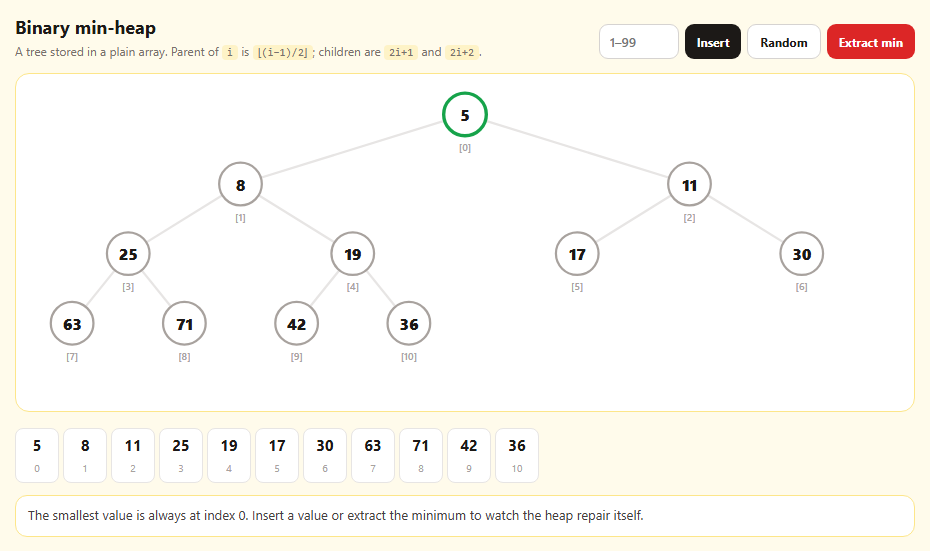
A binary heap is the data structure behind priority queues: task schedulers, event simulations, Dijkstra's shortest path, heap sort, and "top K" problems. Its trick is that it looks like a tree but is stored as a flat array, with parent and child positions computed from indexes. This visualizer draws both views side by side so the connection is obvious.
The shape rule and the order rule
A heap is a *complete* binary tree — every level full except possibly the last, which fills from the left — so it packs into an array with no gaps. The index of a node's parent is ⌊(i − 1) / 2⌋, and its children are at 2i + 1 and 2i + 2. In a *min*-heap, every parent is less than or equal to its children, so the smallest value is always at index 0.
Insert: sift up
A new value goes into the next free array slot, which keeps the shape rule. It may break the order rule, so it is compared with its parent and swapped upward until the parent is smaller or it reaches the root. The tree has ⌊log₂ n⌋ levels, so an insert takes at most that many swaps: O(log n).
Extract-min: sift down
The minimum is the root. Removing it would leave a hole, so the last element moves into the root (keeping the shape) and sinks: at each level it swaps with its smaller child until neither child is smaller. Also O(log n).
Why not just sort?
A sorted array gives the minimum in O(1) but inserting costs O(n) because elements must shift. A heap keeps both operations logarithmic, which is exactly what a priority queue needs.
Reading the animation
Amber cells are being compared and darker cells were just swapped, in both the tree and the array, with each step explained below.
Build with AI
Build, Understand, Optimize, and Extend It With AI
Paste this snippet into an AI assistant like Claude and ask it to prove why sift-up needs at most log₂ n swaps. Ask it to add a max-heap toggle, a "build heap from array" button using O(n) heapify, a heap sort mode, or a decrease-key operation as used by Dijkstra. It can also quiz you: show a heap and ask what it will look like after one more insert.
Prompt to recreate it
Copy this into your AI assistant of choice to build the effect from scratch, or as a jumping-off point for your own variant:
Build an animated binary min-heap visualizer in plain HTML, CSS and JavaScript.

Requirements:
- Store the heap in a plain array and draw it both as an SVG tree (positioned by level and index) and as a row of array cells labelled with their indexes.
- Show the parent and child index formulas on the page.
- Insert a value (1–99, or random): append it, then sift up, highlighting each comparison with the parent and each swap with a short pause and a log message.
- Extract the minimum: take the root, move the last element to the root, then sift down by swapping with the smaller child, with the same highlighting and messages.
- Report the number of swaps compared with floor(log2 n), block new operations while one is animating, limit the demo to 31 values, and skip the pauses for users who prefer reduced motion.
- Start with a pre-built heap of about eleven values.
Want to tighten it up first? Run this prompt through the AI Prompt Studio to score it across 8 quality dimensions, catch anti-patterns, and tune the wording for Claude, ChatGPT, or Gemini before you paste it in.
Source Code
<div class="bh">
  <div class="bh-top">
    <div>
      <h2>Binary min-heap</h2>
      <p>A tree stored in a plain array. Parent of <code>i</code> is <code>⌊(i−1)/2⌋</code>; children are <code>2i+1</code> and <code>2i+2</code>.</p>
    </div>
    <form class="bh-form" id="bhForm">
      <input type="number" id="bhVal" min="1" max="99" placeholder="1–99" aria-label="Value to insert">
      <button type="submit">Insert</button>
      <button type="button" id="bhRand" class="ghost">Random</button>
      <button type="button" id="bhPop" class="pop">Extract min</button>
    </form>
  </div>
  <svg id="bhTree" viewBox="0 0 800 300" role="img" aria-label="Heap as a tree"></svg>
  <div class="bh-array" id="bhArray" aria-label="Heap as an array"></div>
  <div class="bh-log" id="bhLog" aria-live="polite"></div>
</div>*{box-sizing:border-box;margin:0;padding:0}
body{font-family:system-ui,-apple-system,sans-serif;background:#fffbeb;color:#1c1917;min-height:100vh;display:flex;align-items:center;justify-content:center;padding:20px}
.bh{width:100%;max-width:900px}
.bh-top{display:flex;justify-content:space-between;align-items:flex-end;gap:14px;flex-wrap:wrap}
.bh h2{font-size:18px}
.bh-top p{font-size:12px;color:#78716c;margin-top:4px}
.bh code{background:#fef3c7;padding:1px 5px;border-radius:4px;font-size:11px}
.bh-form{display:flex;gap:6px;flex-wrap:wrap}
.bh-form input{width:80px;border:1px solid #d6d3d1;border-radius:9px;padding:8px 10px;font:600 13px system-ui}
.bh-form button{border:0;border-radius:9px;padding:8px 12px;font:700 12px system-ui;background:#1c1917;color:#fff;cursor:pointer}
.bh-form button.ghost{background:#fff;color:#1c1917;border:1px solid #d6d3d1}
.bh-form button.pop{background:#dc2626}
.bh-form button:disabled{opacity:.4;cursor:default}
.bh-form :focus-visible{outline:2px solid #f59e0b;outline-offset:2px}
#bhTree{width:100%;margin-top:14px;background:#fff;border:1px solid #fde68a;border-radius:14px}
#bhTree line{stroke:#e7e5e4;stroke-width:2}
#bhTree circle{fill:#fff;stroke:#a8a29e;stroke-width:2;transition:fill .2s,stroke .2s}
#bhTree text{font:800 14px system-ui;text-anchor:middle;dominant-baseline:central;fill:#1c1917}
#bhTree .idx{font:600 9px system-ui;fill:#a8a29e}
#bhTree .root circle{stroke:#16a34a;stroke-width:3}
#bhTree .cmp circle{fill:#fef3c7;stroke:#f59e0b}
#bhTree .swap circle{fill:#fde68a;stroke:#d97706;stroke-width:3}
.bh-array{display:flex;gap:4px;flex-wrap:wrap;margin-top:12px}
.bh-cell{width:44px;text-align:center;border:1px solid #e7e5e4;border-radius:8px;background:#fff;padding:6px 0}
.bh-cell b{display:block;font-size:15px}
.bh-cell small{font-size:10px;color:#a8a29e}
.bh-cell.cmp{background:#fef3c7;border-color:#f59e0b}
.bh-cell.swap{background:#fde68a;border-color:#d97706}
.bh-log{margin-top:12px;font-size:13px;color:#44403c;background:#fff;border:1px solid #fde68a;border-radius:12px;padding:10px 12px;min-height:42px}var heap = [];
var busy = false;
var tree = document.getElementById('bhTree');
var arr = document.getElementById('bhArray');
var logEl = document.getElementById('bhLog');
var NS = 'http://www.w3.org/2000/svg';
var reduce = window.matchMedia('(prefers-reduced-motion: reduce)').matches;
var PAUSE = reduce ? 0 : 520;
function wait() { return new Promise(function (r) { setTimeout(r, PAUSE); }); }
function parent(i) { return Math.floor((i - 1) / 2); }
// Position of index i: level = floor(log2(i+1)); nodes spread evenly
// across that level. This is only for drawing; the heap is just the array.
function pos(i) {
var level = Math.floor(Math.log2(i + 1));
var first = Math.pow(2, level) - 1;
var slots = Math.pow(2, level);
return [((i - first + 0.5) / slots) * 800, 36 + level * 62];
}
function render(mark) {
mark = mark || {};
tree.innerHTML = '';
heap.forEach(function (_, i) {
if (!i) return;
var a = pos(parent(i)), b = pos(i);
var l = document.createElementNS(NS, 'line');
l.setAttribute('x1', a[0]); l.setAttribute('y1', a[1]); l.setAttribute('x2', b[0]); l.setAttribute('y2', b[1]);
tree.appendChild(l);
});
heap.forEach(function (v, i) {
var p = pos(i);
var g = document.createElementNS(NS, 'g');
g.setAttribute('transform', 'translate(' + p[0] + ',' + p[1] + ')');
g.setAttribute('class', (i === 0 ? 'root ' : '') + (mark[i] || ''));
g.innerHTML = '<circle r="19"></circle><text>' + v + '</text><text class="idx" y="29">[' + i + ']</text>';
tree.appendChild(g);
});
arr.innerHTML = heap.map(function (v, i) {
return '<div class="bh-cell ' + (mark[i] || '') + '"><b>' + v + '</b><small>' + i + '</small></div>';
}).join('') || '<div class="bh-cell"><b>—</b><small>empty</small></div>';
document.getElementById('bhPop').disabled = busy || !heap.length;
}
function log(h) { logEl.innerHTML = h; }
// Insert: append at the end (keeps the tree complete), then "sift up":
// swap with the parent while the parent is larger.
async function insert(v) {
if (heap.length >= 31) { log('Capacity for this demo is 31 values (5 levels).'); return; }
busy = true;
heap.push(v);
var i = heap.length - 1;
var swaps = 0;
log('Insert <b>' + v + '</b> at index ' + i + ', the next free slot, then sift up.');
render({ [i]: 'swap' });
await wait();
while (i > 0) {
var p = parent(i);
render({ [i]: 'cmp', [p]: 'cmp' });
log('Compare ' + heap[i] + ' with parent ' + heap[p] + ' at index ' + p + '.');
await wait();
if (heap[p] <= heap[i]) break;
var t = heap[p]; heap[p] = heap[i]; heap[i] = t;
swaps++;
render({ [p]: 'swap' });
await wait();
i = p;
}
log('Inserted ' + v + ' with ' + swaps + ' swap' + (swaps === 1 ? '' : 's') + '. At most ⌊log₂ n⌋ = ' + Math.floor(Math.log2(heap.length)) + ' swaps are ever needed.');
busy = false;
render();
}
// Extract-min: the root is the answer. Move the LAST element to the root
// and "sift down": swap with the smaller child while a child is smaller.
async function extract() {
if (!heap.length) return;
busy = true;
var min = heap[0];
var last = heap.pop();
if (!heap.length) { log('Extracted <b>' + min + '</b>. The heap is now empty.'); busy = false; render(); return; }
heap[0] = last;
log('Take the root <b>' + min + '</b>. Move the last value ' + last + ' to the root, then sift down.');
render({ 0: 'swap' });
await wait();
var i = 0;
while (true) {
var l = 2 * i + 1, r = 2 * i + 2, smallest = i;
var mark = { [i]: 'cmp' };
if (l < heap.length) mark[l] = 'cmp';
if (r < heap.length) mark[r] = 'cmp';
render(mark);
if (l < heap.length && heap[l] < heap[smallest]) smallest = l;
if (r < heap.length && heap[r] < heap[smallest]) smallest = r;
if (smallest === i) { log('Extracted <b>' + min + '</b>. ' + heap[i] + ' is no larger than its children, so the heap is valid again.'); break; }
log('The smaller child is ' + heap[smallest] + '; swap it with ' + heap[i] + '.');
await wait();
var t = heap[i]; heap[i] = heap[smallest]; heap[smallest] = t;
render({ [smallest]: 'swap' });
await wait();
i = smallest;
}
busy = false;
render();
}
document.getElementById('bhForm').addEventListener('submit', function (e) {
e.preventDefault();
var input = document.getElementById('bhVal');
var v = Math.round(Number(input.value));
if (busy || !(v >= 1 && v <= 99)) return;
input.value = '';
insert(v);
});
document.getElementById('bhRand').addEventListener('click', function () { if (!busy) insert(1 + Math.floor(Math.random() * 99)); });
document.getElementById('bhPop').addEventListener('click', function () { if (!busy) extract(); });
// Seed synchronously (no animation) so the page opens with a real heap.
[42, 17, 8, 63, 25, 11, 30, 5, 71, 19, 36].forEach(function (v) {
heap.push(v);
var i = heap.length - 1;
while (i > 0 && heap[parent(i)] > heap[i]) { var p = parent(i); var t = heap[p]; heap[p] = heap[i]; heap[i] = t; i = p; }
});
render();
log('The smallest value is always at index 0. Insert a value or extract the minimum to watch the heap repair itself.');Step by step
How to Use
- 1Start from the seeded heapEleven values are already arranged as a valid min-heap.
- 2InsertType a value 1–99 or press Random, then watch it sift up.
- 3Extract minThe root is removed and the last value sifts down.
- 4Compare the viewsMatch each tree node to its array index.
- 5Read the logEvery comparison and swap is explained.
Real-world uses
Common Use Cases
Got questions?
Frequently Asked Questions
Nodes are stored level by level from left to right. For a node at index i, its parent is at floor((i − 1) / 2) and its children are at 2i + 1 and 2i + 2. Because the tree is complete, the array has no gaps.
In a min-heap every parent is less than or equal to its children, so the root holds the minimum. In a max-heap every parent is greater than or equal to its children, so the root holds the maximum. Only the comparison changes.
Insert and extract are O(log n) because values move along one root-to-leaf path. Reading the minimum is O(1). Building a heap from n items can be done in O(n) with bottom-up heapify.
Removing the root leaves a hole. Moving the last element into it keeps the tree complete, and sifting it down restores the ordering in O(log n).
No. Only the parent-child relationship is ordered; siblings and cousins can be in any order. That weaker guarantee is what makes inserts and extracts cheap.