Learn Coding Visually
Learn to code with interactive, live-preview playgrounds — HTML, CSS, JavaScript, React & more.
 HTML Playground42 lessons · Click-based · Live preview
 CSS PlaygroundLearn CSS with a live editor
 JavaScript Playground60 lessons · DOM · Async · Canvas
 React PlaygroundLearn React with a live code editor
 GSAP PlaygroundLearn GSAP animation interactively
 SVG Playground44 lessons · shapes · paths · animation
 SCSS Playground45 lessons · Sass modules · tokens
 Tailwind PlaygroundLearn Tailwind CSS with a live editor
 Bootstrap 5 Playground50 lessons · live preview
Three.js Scroll Shader Fluid Gradient Wave — GLSL ShaderMaterial Driven by Scroll
Three.js Scroll Shader Fluid Gradient Wave · Scroll · Plain HTML, CSS & JS · Live preview
What's included
Features
About this UI Snippet
How to Build a Scroll-Driven Fluid Gradient Wave Shader With Three.js
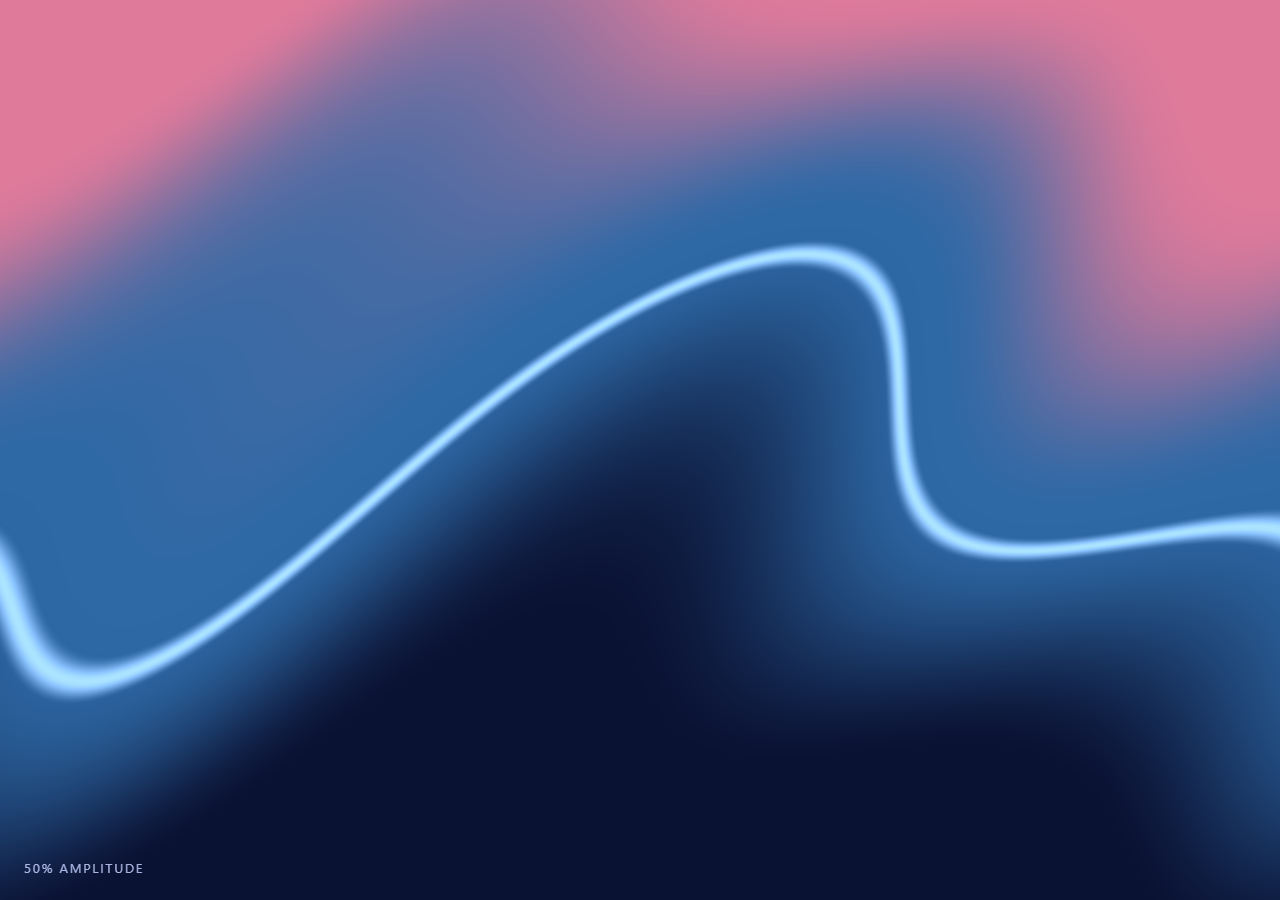
The Three.js Scroll Shader Fluid Gradient Wave snippet renders a single full-viewport plane with a custom THREE.ShaderMaterial whose fragment shader combines several sine and cosine waves into a smoothly undulating color band, then mixes three colors across that band — and as the visitor scrolls through a pinned section, both the wave's amplitude/speed and the gradient's color mix shift together, driven entirely by a uProgress uniform.
Layered waves, not one sine function
The shader sums three separate wave terms — wave1 (a fast horizontal sine), wave2 (a diagonal sine combining both UV axes), and wave3 (a slower vertical cosine) — each with its own frequency and phase speed, into a single band value derived from uv.y plus all three waves. Layering multiple simple waves like this is what keeps the result reading as organically fluid rather than as one obviously periodic ripple — the same layering principle used in Scroll Canvas Generative Flow Field's procedural vector field, applied here inside a fragment shader instead of a Canvas2D loop.
A three-color gradient mixed by band position
Two chained mix()/smoothstep() pairs blend from a deep base color through a mid tone into a bright accent color, based on where band falls — since band already has the wave terms baked in, the color transitions themselves visibly ripple and shift, rather than sitting on top of a static gradient.
One uniform driving three things at once
uProgress simultaneously scales speed (how fast the waves animate), amp (how pronounced the waves are), and hueShift (how far the mid and accent colors drift toward a secondary palette via their own mix() calls) — so scrolling further doesn't just speed up the waves, it also intensifies them and shifts the whole gradient's mood, all from one float written into the material each frame.
A thin sheen highlight for extra polish
A narrow smoothstep band around band == 0.5 adds a subtle bright sheen line that rides along with the wave crest, a cheap way to suggest a glossy, liquid-like surface without any lighting model or normal calculation.
uTime versus uProgress
Exactly as in Three.js Scroll Shader Ripple Distortion, uTime advances continuously from a THREE.Clock so the surface never fully stops moving, while uProgress is scroll-bound and controls only the wave's intensity and speed multiplier — two uniforms with two distinct jobs.
Customizing it
Swap the three base colors for your own palette, add a fourth wave term at yet another frequency for more visual complexity, or change hueShift's target colors for a completely different mood shift as the user scrolls. Pair it with Three.js Scroll Shader Ripple Distortion for a related uniform-driven GLSL technique using radial rather than banded waves.
Build with AI
Build, Understand, Optimize, and Extend It With AI
You do not need to derive multi-wave shader composition or uniform-driven color shifting from scratch. Paste this snippet's HTML, CSS, and JS into an AI assistant like Claude and ask it to explain exactly why layering three differently-tuned sine/cosine terms into one band value produces an organically fluid look instead of a single mechanical ripple, and how the same uProgress uniform manages to control wave amplitude, wave speed, and gradient color mix simultaneously. The same assistant can help you extend it — ask it to add a fourth wave term for even more complexity, expose the base palette as easily swappable uniforms, or add a subtle grain/noise overlay for a more textured, less flat-shaded look. Treat the code as a conversation starter, not a finished artifact.
Prompt to recreate it
Copy this into your AI assistant of choice to build the effect from scratch, or as a jumping-off point for your own variant:
Build a "scroll-driven fluid gradient wave" in plain HTML, CSS, and JavaScript using Three.js with a custom ShaderMaterial, plus GSAP and GSAP's ScrollTrigger plugin, all loaded from a CDN (no bundler, no build step).

Requirements:
- A pinned section containing a full-size canvas, rendered with an OrthographicCamera set to view exactly [-1, 1] on both axes, and a single PlaneGeometry(2, 2) mesh using a custom THREE.ShaderMaterial, so the plane fills the viewport at any aspect ratio.
- A vertex shader that is a standard passthrough: pass the built-in uv attribute to a varying vUv, and set gl_Position using projectionMatrix * modelViewMatrix * vec4(position, 1.0).
- A fragment shader that sums at least three separate wave terms (a mix of sin() and cos(), varying frequency, axis combination, and phase speed) into one combined "band" value derived from the UV coordinate, producing a result that looks organically fluid rather than a single obvious periodic ripple.
- Two uniforms driving the animation: a uProgress float uniform (updated every frame from a value kept in sync with scroll position) that scales the waves' amplitude and speed together, and a uTime float uniform (updated every frame from an elapsed-time clock, independent of scroll) that drives the waves' continuous phase so the surface never fully stops moving.
- Render a smooth gradient of at least three colors mixed based on the combined band value using chained smoothstep()/mix() calls, and blend the gradient's mid and accent colors toward a secondary palette as uProgress increases, so scrolling further shifts both the wave's motion and the gradient's overall color mood.
- Add a thin, subtly brighter sheen highlight computed with smoothstep around one specific band value, to suggest a glossy liquid surface with no actual lighting model.
- Register a GSAP tween on a ScrollTrigger targeting the pinned section, with pin: true, start at top top, a numeric scrub, and a multi-hundred-percent end, animating a single plain progress value from 0 to 1 with linear easing, and write that value into the uProgress uniform every animation frame.
- Confirm scrolling back up smoothly calms the waves and reverts the gradient toward its resting color mix.
Want to tighten it up first? Run this prompt through the AI Prompt Studio to score it across 8 quality dimensions, catch anti-patterns, and tune the wording for Claude, ChatGPT, or Gemini before you paste it in.
Source Code
<section class="fgw-stage" id="fgwStage">
  <div class="fgw-intro-overlay"><p>Scroll ↓ to stir the gradient</p></div>
  <canvas id="fgwCanvas"></canvas>
  <div class="fgw-hud"><span id="fgwPct">0</span>% amplitude</div>
</section>
<section class="fgw-bottom"><p>A single ShaderMaterial plane, waving entirely on the GPU.</p></section>*{box-sizing:border-box;margin:0;padding:0}
html,body{background:#040308;color:#fff;font-family:system-ui,-apple-system,sans-serif}
.fgw-bottom{min-height:70vh;display:flex;justify-content:center;align-items:center;color:#a8b3d6;font-size:15px;letter-spacing:.08em;text-transform:uppercase;text-align:center;padding:0 24px}
.fgw-stage{height:100vh;position:relative;overflow:hidden;background:#040308}
.fgw-intro-overlay{position:absolute;inset:0;display:flex;align-items:center;justify-content:center;text-align:center;padding:24px;pointer-events:none;z-index:5;color:#eef0ff;font-size:15px;letter-spacing:.08em;text-transform:uppercase;text-shadow:0 2px 16px rgba(0,0,0,.6);transition:opacity .4s ease}
#fgwCanvas{display:block;width:100%;height:100%}
.fgw-hud{position:absolute;left:24px;bottom:24px;font-variant-numeric:tabular-nums;font-size:13px;letter-spacing:.14em;color:#c7d2ff;text-transform:uppercase;opacity:.85}const canvas = document.getElementById('fgwCanvas');
const pctEl = document.getElementById('fgwPct');
const introEl = document.querySelector('.fgw-intro-overlay');
const renderer = new THREE.WebGLRenderer({ canvas, antialias: true });
renderer.setPixelRatio(Math.min(window.devicePixelRatio, 2));
const scene = new THREE.Scene();
const camera = new THREE.OrthographicCamera(-1, 1, 1, -1, 0, 1);
const vertexShader = [
'varying vec2 vUv;',
'void main() {',
' vUv = uv;',
' gl_Position = projectionMatrix * modelViewMatrix * vec4(position, 1.0);',
'}',
].join('\n');
const fragmentShader = [
'precision highp float;',
'varying vec2 vUv;',
'uniform float uProgress;',
'uniform float uTime;',
'',
'void main() {',
' vec2 uv = vUv;',
'',
' float speed = 0.35 + uProgress * 0.9;',
' float amp = 0.06 + uProgress * 0.16;',
'',
' float wave1 = sin(uv.x * 6.0 + uTime * speed) * amp;',
' float wave2 = sin((uv.x * 3.0 - uv.y * 2.0) * 4.0 + uTime * speed * 1.4) * amp * 0.6;',
' float wave3 = cos(uv.y * 5.0 - uTime * speed * 0.7) * amp * 0.4;',
'',
' float band = uv.y + wave1 + wave2 + wave3;',
'',
' vec3 colorA = vec3(0.04, 0.07, 0.20);',
' vec3 colorB = vec3(0.10, 0.45, 0.62);',
' vec3 colorC = vec3(0.85, 0.42, 0.66);',
'',
' float hueShift = uProgress * 0.35;',
' vec3 shiftedB = mix(colorB, vec3(0.55, 0.22, 0.78), hueShift);',
' vec3 shiftedC = mix(colorC, vec3(0.98, 0.75, 0.35), hueShift);',
'',
' vec3 color = mix(colorA, shiftedB, smoothstep(0.15, 0.55, band));',
' color = mix(color, shiftedC, smoothstep(0.55, 0.95, band));',
'',
' float sheen = smoothstep(0.48, 0.5, band) * (1.0 - smoothstep(0.5, 0.52, band));',
' color += sheen * 0.5;',
'',
' gl_FragColor = vec4(color, 1.0);',
'}',
].join('\n');
const uniforms = {
uProgress: { value: 0 },
uTime: { value: 0 },
};
const material = new THREE.ShaderMaterial({
vertexShader,
fragmentShader,
uniforms,
});
const geometry = new THREE.PlaneGeometry(2, 2);
const mesh = new THREE.Mesh(geometry, material);
scene.add(mesh);
gsap.registerPlugin(ScrollTrigger);
const progress = { t: 0 };
gsap.to(progress, {
t: 1,
ease: 'none',
scrollTrigger: {
trigger: '#fgwStage',
start: 'top top',
end: '+=350%',
scrub: 0.6,
pin: true,
},
});
function resize() {
const w = canvas.clientWidth, h = canvas.clientHeight;
renderer.setSize(w, h, false);
}
const clock = new THREE.Clock();
function animate() {
requestAnimationFrame(animate);
if (introEl) introEl.style.opacity = (progress.t > 0.03) ? '0' : '1';
uniforms.uProgress.value = progress.t;
uniforms.uTime.value = clock.getElapsedTime();
pctEl.textContent = Math.round(progress.t * 100);
renderer.render(scene, camera);
}
resize();
window.addEventListener('resize', resize);
animate();Step by step
How to Use
- 1Load all three CDN scriptsAdd three.min.js, gsap.min.js, and ScrollTrigger.min.js from the CDN panel, in that order.
- 2Paste HTML, CSS, and JSAn undulating full-viewport gradient plane renders inside a pinned stage with a live "% amplitude" read-out.
- 3Scroll downThe waves grow faster and more pronounced, and the gradient shifts toward a secondary color palette.
- 4Scroll back upThe waves calm and the color mix reverts to its resting palette exactly in reverse.
- 5Retune the wavesAdjust each wave term’s frequency and phase-speed multiplier in the fragment shader for a different rhythm.
- 6Swap the paletteChange colorA/colorB/colorC (and their hueShift targets) for a completely different mood.
Real-world uses
Common Use Cases
Got questions?
Frequently Asked Questions
A single sine wave reads as an obviously mechanical, uniform ripple. Summing three terms at different frequencies, axis combinations, and phase speeds (wave1, wave2, wave3) into one band value produces a result that looks organically fluid, since no single periodic pattern dominates the visible motion.
uProgress is a single float updated every animation frame from a value kept in sync with a scrubbed GSAP ScrollTrigger tween. It scales the waves’ speed and amplitude, and also drives a hueShift value used to blend the gradient’s mid and accent colors toward a secondary palette — so scrolling further makes the surface simultaneously wavier, faster, and more vividly colored.
uTime advances continuously from a THREE.Clock every frame regardless of scroll position, keeping the wave phase animating even if the user stops scrolling. uProgress only reflects scroll position and controls intensity/speed multipliers, not the base animation phase — the two uniforms serve distinct roles.
A narrow smoothstep window centered on band == 0.5 (using two chained smoothstep calls to build a thin band rather than a hard edge) adds a small amount of extra brightness only where the band value passes through that midpoint, producing a bright line that rides along the wave crest with no lighting model or normal-vector calculation needed.
Yes. Click JSX for a React component, Vue for a Vue 3 SFC, Angular for a standalone component, or Tailwind for a React + Tailwind version. Build the renderer, shader material, and GSAP ScrollTrigger inside a mount effect keyed to a canvas ref, and on unmount kill the ScrollTrigger instance, dispose the geometry and material, and call renderer.dispose().