

Learn Coding Visually
Learn to code with interactive, live-preview playgrounds — HTML, CSS, JavaScript, React & more.
 HTML Playground42 lessons · Click-based · Live preview
 CSS PlaygroundLearn CSS with a live editor
 JavaScript Playground60 lessons · DOM · Async · Canvas
 React PlaygroundLearn React with a live code editor
 GSAP PlaygroundLearn GSAP animation interactively
 SVG Playground44 lessons · shapes · paths · animation
 SCSS Playground45 lessons · Sass modules · tokens
 Tailwind PlaygroundLearn Tailwind CSS with a live editor
 Bootstrap 5 Playground50 lessons · live preview
Multi-Directional 2D Slider — HTML CSS JS Snippet
Multi-Directional 2D Slider · Misc · Plain HTML, CSS & JS · Live preview
What's included
Features
About this UI Snippet
Multi-Directional 2D Slider — One Transform, Two Axes at Once

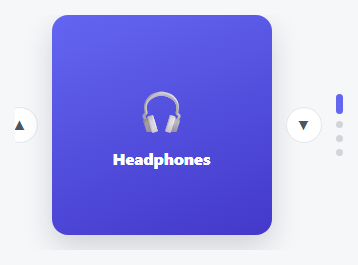
Every other carousel in this library moves along a single axis. This one drops that constraint entirely: nine cells sit in a real 3×3 CSS Grid, and a single translate(x, y) transform pans that grid within a fixed viewport — so dragging diagonally moves *both* axes simultaneously in one continuous motion, not two separate horizontal-then-vertical slides.
Column and row as the real state, translate as its rendering
Just like the other carousels in this collection, the actual state isn't a pixel offset — it's two small integers, col and row, each clamped between 0 and 2. render() is the only place they become a transform: translate(-col * CELL, -row * CELL). The D-pad buttons and arrow keys both just increment or decrement col/row by one and call render() — clean, discrete, always-aligned movement.
Free drag, then reconciled back to that same discrete state
During an active drag, the grid's transform is set directly to follow the pointer in both axes at once — genuinely free movement, not constrained to a straight line. The moment the pointer releases, the code reads the grid's *actual current rendered transform* back out via getComputedStyle and a DOMMatrixReadOnly, divides by the cell size, and rounds to the nearest whole col/row — snapping the free-form drag position back onto the same clean integer grid the buttons and keys use, so however you moved, you always land squarely on one of the nine cells.
Build with AI
Build, Understand, Optimize, and Extend It With AI
Paste this snippet's HTML, CSS, and JS into an AI coding assistant like Claude and ask it to explain exactly how DOMMatrixReadOnly is used to read the grid's actual rendered transform back out after a free-form drag, and why that's necessary instead of just tracking the drag delta directly in JavaScript variables throughout the gesture. It's also worth asking the assistant to add wrap-around navigation (so moving right from the last column jumps to the first), or to add momentum/inertia to the release the same way the Momentum Drag Carousel snippet does, but across both axes at once.
Prompt to recreate it
Copy this into your AI assistant of choice to build the effect from scratch, or as a jumping-off point for your own variant:
Build a slider that navigates a 3x3 grid of slides in any direction — including diagonally — using a single combined transform, in plain HTML, CSS, and vanilla JavaScript, no library.

Requirements:
- Nine slide/cell elements arranged in a real 3-column by 3-row CSS Grid, all contained within a grid element that is larger than a fixed-size viewport container which clips it via overflow hidden.
- The current position must be tracked as two small integers (a column index and a row index, each ranging from 0 to 2), which are the single source of truth — a render function must be the only place that converts these two integers into a CSS transform translating the grid by negative (column times cell size) horizontally and negative (row times cell size) vertically.
- A directional pad UI with four buttons (up, down, left, right) that each move exactly one column or row in that direction, clamped so movement stops at the grid's edges and cannot go out of bounds.
- Free-form dragging (via pointer events with touch fallback) that pans the grid smoothly to follow the pointer in BOTH horizontal and vertical directions simultaneously during the drag — including diagonal movement — not constrained to a single axis, with no CSS transition applied while actively dragging so it tracks the pointer exactly.
- On drag release, the grid's actual current rendered transform must be read back out programmatically (not estimated from the drag delta alone) and converted back into the nearest valid whole column and row, then the grid must animate smoothly to snap into perfect alignment with that cell, clamped within the same bounds as the directional pad.
- Full arrow key support performing the same one-cell-at-a-time movement as the directional pad buttons, in all four directions.
Want to tighten it up first? Run this prompt through the AI Prompt Studio to score it across 8 quality dimensions, catch anti-patterns, and tune the wording for Claude, ChatGPT, or Gemini before you paste it in.
Source Code
<div class="mds-wrap">
  <div class="mds-viewport" id="mdsViewport">
    <div class="mds-grid" id="mdsGrid">
      <div class="mds-cell" style="background:linear-gradient(160deg,#6366f1,#4338ca)">1</div>
      <div class="mds-cell" style="background:linear-gradient(160deg,#0ea5e9,#0369a1)">2</div>
      <div class="mds-cell" style="background:linear-gradient(160deg,#ec4899,#9d174d)">3</div>
      <div class="mds-cell" style="background:linear-gradient(160deg,#10b981,#047857)">4</div>
      <div class="mds-cell" style="background:linear-gradient(160deg,#f59e0b,#b45309)">5</div>
      <div class="mds-cell" style="background:linear-gradient(160deg,#8b5cf6,#5b21b6)">6</div>
      <div class="mds-cell" style="background:linear-gradient(160deg,#ef4444,#991b1b)">7</div>
      <div class="mds-cell" style="background:linear-gradient(160deg,#14b8a6,#0f766e)">8</div>
      <div class="mds-cell" style="background:linear-gradient(160deg,#eab308,#854d0e)">9</div>
    </div>
  </div>
  <div class="mds-pad" id="mdsPad">
    <button class="mds-dir mds-up" data-dx="0" data-dy="1" aria-label="Move up">▲</button>
    <button class="mds-dir mds-left" data-dx="1" data-dy="0" aria-label="Move left">◀</button>
    <div class="mds-dot"></div>
    <button class="mds-dir mds-right" data-dx="-1" data-dy="0" aria-label="Move right">▶</button>
    <button class="mds-dir mds-down" data-dx="0" data-dy="-1" aria-label="Move down">▼</button>
  </div>
</div>*{box-sizing:border-box;margin:0;padding:0}
body{font-family:system-ui,-apple-system,sans-serif;background:#0f1117;min-height:100vh;display:flex;flex-direction:column;align-items:center;justify-content:center;gap:22px;padding:24px}
.mds-viewport{width:220px;height:220px;overflow:hidden;border-radius:16px;box-shadow:0 16px 36px rgba(0,0,0,.5)}
.mds-grid{display:grid;grid-template-columns:repeat(3,220px);grid-template-rows:repeat(3,220px);width:660px;height:660px;transition:transform .4s cubic-bezier(.4,0,.2,1);touch-action:none;cursor:grab}
.mds-grid.mds-grabbing{cursor:grabbing}
.mds-cell{display:flex;align-items:center;justify-content:center;font-size:60px;font-weight:800;color:rgba(255,255,255,.9)}
.mds-pad{display:grid;grid-template-columns:repeat(3,34px);grid-template-rows:repeat(3,34px);gap:4px;place-items:center}
.mds-up{grid-column:2;grid-row:1}
.mds-left{grid-column:1;grid-row:2}
.mds-dot{grid-column:2;grid-row:2;width:8px;height:8px;border-radius:50%;background:#2a3348}
.mds-right{grid-column:3;grid-row:2}
.mds-down{grid-column:2;grid-row:3}
.mds-dir{width:34px;height:34px;border-radius:8px;background:#161c2c;border:1px solid #2a3348;color:#cbd5e1;font-size:13px;cursor:pointer;display:flex;align-items:center;justify-content:center;transition:background .15s,color .15s}
.mds-dir:hover{background:#232c42;color:#fff}var viewport = document.getElementById('mdsViewport');
var grid = document.getElementById('mdsGrid');
var CELL = 220;
var col = 1, row = 1; // start centered on cell "5"
var minCol = 0, maxCol = 2, minRow = 0, maxRow = 2;
function render() {
grid.style.transform = 'translate(' + (-col * CELL) + 'px, ' + (-row * CELL) + 'px)';
}
function move(dx, dy) {
col = Math.max(minCol, Math.min(maxCol, col - dx));
row = Math.max(minRow, Math.min(maxRow, row - dy));
render();
}
document.querySelectorAll('.mds-dir').forEach(function (btn) {
btn.addEventListener('click', function () {
move(parseInt(btn.dataset.dx, 10), parseInt(btn.dataset.dy, 10));
});
});
// Free drag across both axes, snapping to the nearest cell on release
var dragging = false;
var startX = 0, startY = 0, baseX = 0, baseY = 0;
function currentTranslate() {
return { x: -col * CELL, y: -row * CELL };
}
function pointerDown(e) {
dragging = true;
grid.classList.add('mds-grabbing');
grid.style.transition = 'none';
var t = currentTranslate();
baseX = t.x; baseY = t.y;
startX = e.touches ? e.touches[0].clientX : e.clientX;
startY = e.touches ? e.touches[0].clientY : e.clientY;
}
function pointerMoveHandler(e) {
if (!dragging) return;
var x = e.touches ? e.touches[0].clientX : e.clientX;
var y = e.touches ? e.touches[0].clientY : e.clientY;
var tx = baseX + (x - startX);
var ty = baseY + (y - startY);
grid.style.transform = 'translate(' + tx + 'px, ' + ty + 'px)';
}
function pointerUpHandler(e) {
if (!dragging) return;
dragging = false;
grid.classList.remove('mds-grabbing');
grid.style.transition = '';
var style = getComputedStyle(grid).transform;
var matrix = new DOMMatrixReadOnly(style);
col = Math.max(minCol, Math.min(maxCol, Math.round(-matrix.m41 / CELL)));
row = Math.max(minRow, Math.min(maxRow, Math.round(-matrix.m42 / CELL)));
render();
}
viewport.addEventListener('pointerdown', pointerDown);
window.addEventListener('pointermove', pointerMoveHandler);
window.addEventListener('pointerup', pointerUpHandler);
viewport.addEventListener('touchstart', pointerDown, { passive: true });
window.addEventListener('touchmove', pointerMoveHandler, { passive: true });
window.addEventListener('touchend', pointerUpHandler);
document.addEventListener('keydown', function (e) {
if (e.key === 'ArrowUp') move(0, 1);
else if (e.key === 'ArrowDown') move(0, -1);
else if (e.key === 'ArrowLeft') move(1, 0);
else if (e.key === 'ArrowRight') move(-1, 0);
});
render();Step by step
How to Use
- 1Paste HTML, CSS, and JSA viewport shows one cell of a 3×3 grid, centered on cell "5", with a directional pad beside it.
- 2Drag in any directionIncluding diagonally — the grid pans freely to follow your cursor across both axes at once.
- 3ReleaseThe grid snaps to whichever cell ended up most centered, aligning perfectly.
- 4Use the D-pad or arrow keysMove exactly one cell at a time in any of the four cardinal directions.
- 5Reach an edgeMovement stops cleanly at the grid's boundary — no cell "5" can accidentally scroll past cell "1" or "9".
Real-world uses
Common Use Cases
Got questions?
Frequently Asked Questions
Add more .mds-cell elements to fill the new grid, update .mds-grid's grid-template-columns/rows and total width/height to match, and update minCol/maxCol/minRow/maxRow (and the starting col/row) to the new bounds.
getComputedStyle(grid).transform returns the grid's exact current rendered transform matrix as a string; parsing it with DOMMatrixReadOnly gives the real x/y translation values, which are then divided by the cell size and rounded to the nearest whole column and row.
Replace the Math.max/Math.min clamping in move() and in the drag-release handler with a modulo operation against the grid's column/row count, so moving past the last column wraps back to the first.
Yes — restrict the D-pad to left/right (or up/down) buttons only, and in the drag handlers, only apply the x (or y) component of the pointer delta to the transform.
The D-pad buttons are real, labeled <button> elements, and the entire grid is also operable via all four arrow keys — both provide a fully mouse/touch-independent way to navigate the same grid.